


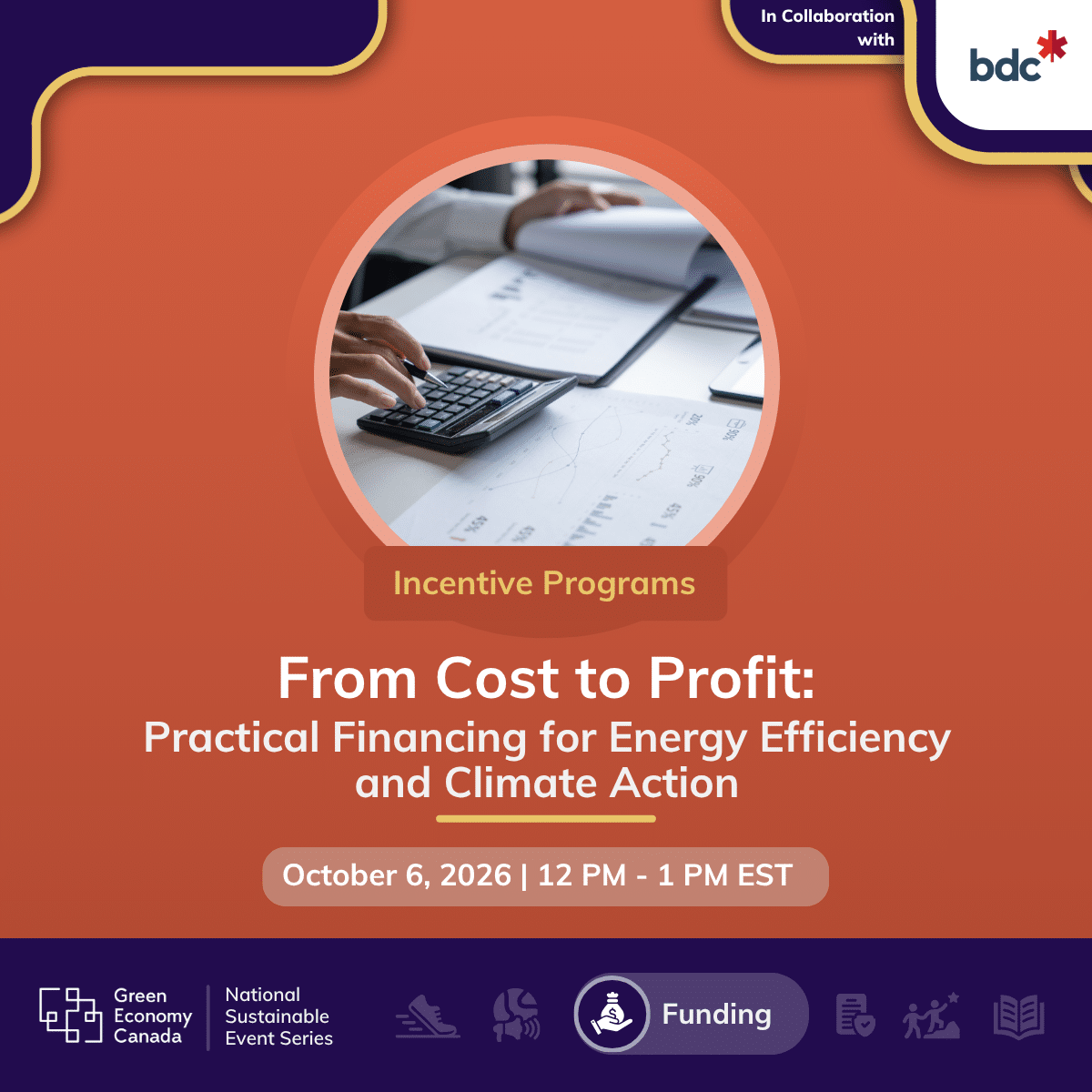

From Cost to Profit:
How Canadian SMEs can Finance Energy Efficiency and Climate Action


From Cost to Profit:
How Canadian SMEs can Finance Energy Efficiency and Climate Action
Key Takeaways from the GEC-BDC National Virtual Event
October 2026
From Cost to Profit: How Canadian SMEs can Finance Energy Efficiency and Climate Action
For many small and medium-sized enterprises (SMEs), taking action on energy and climate can feel like a costly luxury during times of tight margins and economic uncertainty. Upfront prices on high-efficiency equipment or building retrofits often make sustainability seem financially out of reach. However, when approached strategically, these investments transition from a burdensome expense into one of the most effective drivers of operational cost savings and long-term profitability.
Green Economy Canada (GEC) and the Business Development Bank of Canada (BDC) recently co-hosted a national webinar to demystify the funding landscape and demonstrate how businesses can transform environmental action into measurable bottom-line value. Moderated by Matthew Lynch (Executive Director, Green Economy Canada), the session featured expert insights from Carla Heim (Lead, Sustainability, BDC), Debbie Scharf (Director, Energy Conservation, Enbridge Gas), Stephanie McLarty (Head of Sustainability, Quantum Lifecycle Partners), and Fulya Karakas-Akgun (Director of Sustainability, Polaris Transportation Group).
Featured Speaker Panel

Carla Heim
Lead of Sustainability
BDC

Debbie Scharf,
Director, Energy Conservation
Enbridge Gas

Fulya Karakas-Akgun,
Director of Sustainability
Polaris Transportation Group

Stephanie McLarty
Head of Sustainability
Quantum Lifecycle Partners

Facilitated by the Executive Director of Green Economy Canada
Matthew Lynch
Here are the primary takeaways and real-world strategies shared by our panel of business leaders, energy experts, and financiers.
1. Start with the Biggest Business Opportunity
- Focus on operational friction: Look at your highest costs or pain points, such as high utility bills, aging heating, ventilation, and air condition (HVAC) units, inefficient equipment run-times.
- Low-hanging operational fixes: Small adjustments to temperature set points, equipment scheduling, or water usage can yield immediate cost savings without capital heavy expenditure.
- Multi-benefit investments: Energy upgrades frequently deliver hidden operational dividends. For instance, Polaris Transportation Group transitioned from propane to electric forklifts, reducing fuel costs and carbon emissions while dramatically improving indoor air quality and worker safety on their loading docks.


– Carla Heim, Lead of Sustainability, BDC
– Debbie Scharf, Director, Energy Conservation, Enbridge Gas
2. Unlocking Grants, Subsidies, and Utility Incentives
While financial incentives are broadly accessible through federal programs, tax provisions, and local utilities across Canada, a significant portion goes unclaimed due to a lack of awareness among business owners.
As Stephanie McLarty, Head of Sustainability at Quantum Lifecycle Partners, shared, one of the most effective habits a business can build is reviewing available incentives every fall before deciding on the next annual initiatives. By scanning for grants, rebates, and subsidies during fall budgeting, you can map out what projects are feasible based on actual available funding, shortening payback periods and making CFO approval much easier.
Panelists highlighted several key avenues and strategies:
- Timing & Planning: Build an annual fall review of regional and national incentive options into your budgeting cycle to assess available funding before finalizing next year’s operational projects. Ensure incentives are identified early in the project planning process.
- Vendor Expertise: Contractors and equipment suppliers are valuable information sources who can help identify rebate opportunities, handle application paperwork, and structure quotes around applied incentives.
- Utility Partner Programs: Utilities like Enbridge Gas offer direct-install options for small businesses, standardized prescriptive rebates for common upgrades, and custom incentive streams for complex technical projects.
- Tax Credits: Under the CRA Clean Technology Investment Tax Credit, businesses purchasing eligible clean equipment (such as electric forklifts or rooftop solar) can recover approximately 30% of capital costs through annual tax filings.


– Fulya Karakas-Akgun, Director of Sustainability, Polaris Transportation Group
– Stephanie McLarty, Head of Sustainability, Quantum Lifecycle Partners
3. How to Build a Winning Business Case for Lenders
Securing external financing for energy efficiency or climate action shouldn’t feel like a black box. As Carla Heim, Lead of Sustainability at BDC, emphasized during the panel, lenders evaluate sustainability investments using the exact same financial rigor as any other core business initiative. Lenders don’t finance good intentions — they finance well-prepared, credible projects backed by clear facts and measurable outcomes.
To dramatically increase your chances of securing approval — whether pitching an external bank or making an internal business case to your CFO — Carla recommends having clear, quantitative answers ready for these six questions:
- Purchasing details: What equipment or building systems are you buying or upgrading?
- Immediate capital: What is the exact upfront investment required today?
- Total project cost: What are the fully installed costs, minus pre-secured incentives?
- Measurable business benefits: What are the estimated annual energy savings, reduced maintenance costs, or productivity gains?
- Risk mitigation: What operational or financial risks have you evaluated?
- Repayment plan: How will the generated cash flow or energy savings cover loan repayment terms?
For businesses seeking capital for larger retrofits, sustainable financial products are expanding rapidly. Options range from BDC’s Green Building Certification Loan — which offers interest rate reductions for eco-certified commercial building retrofits — to Sustainability-Linked Loans available through major commercial banks. As Stephanie McLarty noted, companies operating with a dedicated sustainable business model (where 80% or more of revenue comes from environmentally friendly activities, such as electronics reuse and recycling) can often qualify for these favourable loan structures with reduced annual reporting requirements.
Key Steps to Get Started Today
Review your energy footprint: Schedule a site walk-through or leverage a free advisor audit from your local energy utility or contractor to spot quick wins.
Incorporate incentives early: Before finalizing budgets or procurement timelines, map out applicable grants, rebates, and tax credits to improve your project’s ROI.
Leverage free national resources: Explore our free resources in the section below to help you get started on funding your sustainability initiatives.
Free Tools and Resources for Business Sustainability Financing
Courtesy of our Panelists and Green Economy Canada
Explore the key tools, funding programs, and support services highlighted by our panel to help kickstart and finance your business’s sustainability journey.
1. Financing Guides & Measurement Tools
2. Utility Incentives & Expert Support
3. Federal & Regulatory Programs
4. Educational & Learning Opportunities
Watch the Full Webinar
Missed the live discussion? You can watch the full recording of From Cost to Profit: Practical Financing for Energy Efficiency and Climate Action to hear the complete discussion, panelist recommendations, and live Q&A.
Taking climate action is no longer just an environmental goal — it is a practical strategy for improving profitability and long-term business resilience.
Looking for direct guidance on how your business can measure impact and navigate sustainability retrofits? Connect with Green Economy Canada to learn more about how we can support your business take climate action and improve your bottom line.