


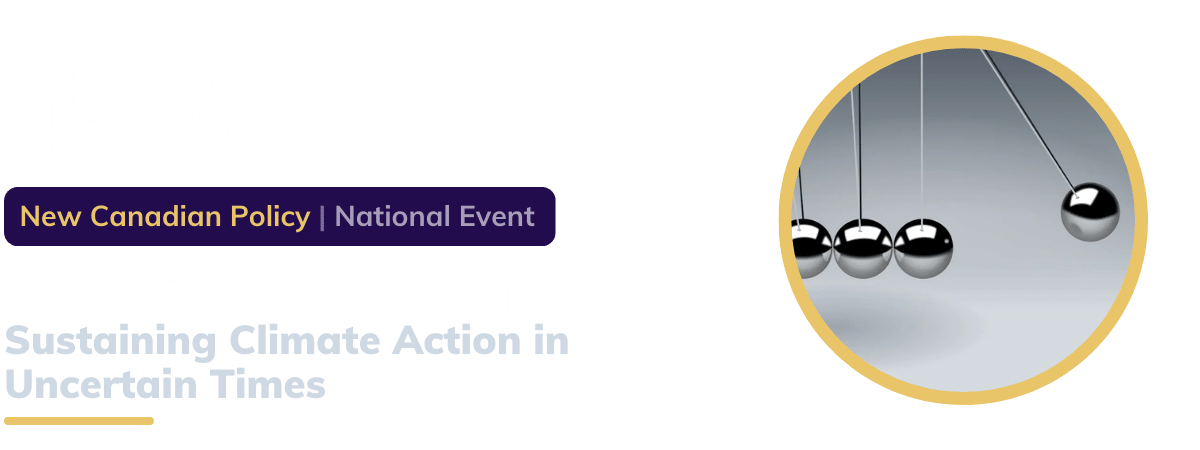
On February 27, 2025, Green Economy Canada held an event called
Maintaining Momentum: Sustaining Climate Action in Uncertain Times.
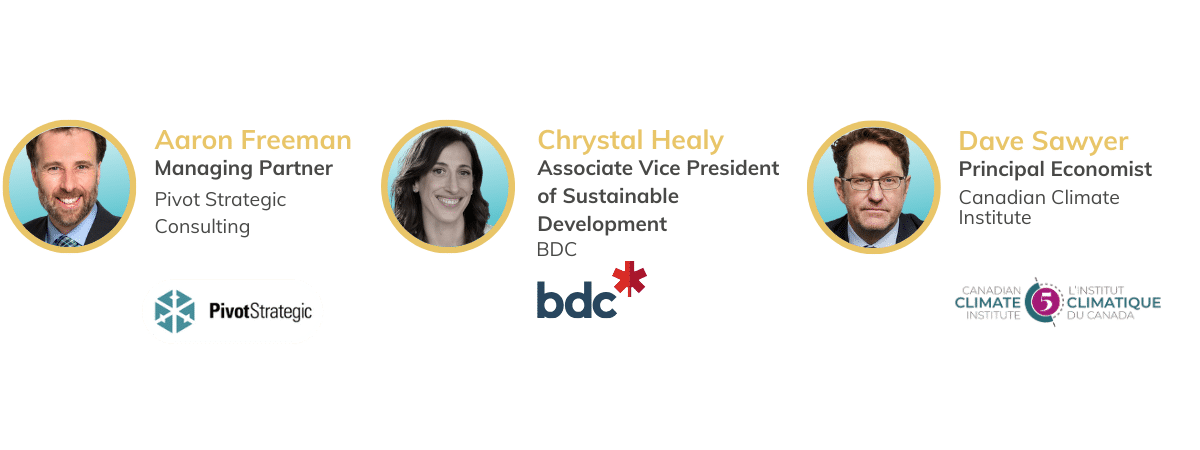
Thank you to our speakers:
From tariffs to the dismantling of climate policies and commitments, the current political landscape is creating a lot of uncertainty. Our panel of experts came together to discuss how the landscape is changing and how approaches to advancing our collective progress to net-zero might evolve.
This post summarizes some of the key takeaways and provides links
to the recording and supplemental resources to take your learning further.
How is the landscape changing?
It’s important to be aware of what has not changed in the sustainability landscape. While there is a great deal of discussion (and rhetoric) about backlash, the panelists pointed out that, once you block out the “noise”, the underlying “signal” remains consistent: the green economy continues to drive economic growth. As one panelist noted, “the train has left the station.”
Underlying realities cited include:
- Wind and solar remain the cheapest forms of energy worldwide.
- The job market in clean energy is growing twice as fast as other sectors.
- Canadian exports of clean energy-related goods outperform other similar “baskets of commodities” at a rate of 3:1.
- Electric vehicle parts manufacturing is seeing 90% year-over-year growth.
- Energy efficiency always pays off.
Ultimately, the green economy has demonstrated growth and resilience.
But sitting on top of that deeper fact are some important trends: affordability issues have overtaken environmental issues in the minds of voters, while climate action has become politicized in a hyper-partisan landscape. This creates a certain pressure for businesses to pull back from sustainable initiatives, as well as similar policies like Diversity, Equity & Inclusion.
How can we evolve our approach?
Understanding that the terms of the discussion (the “noise” so to speak) have changed, but the underlying reality of the green economy (the “signal”) has not, how can we continue to demonstrate the value of the green energy transition and respond to these challenges?
Even before the recent pivots by the new US government, conversations about business sustainability were beginning to include more discussion around business adaptation in addition to mitigation. Potential supply chain interruption, service interruptions (internet, power, water, etc) and employee health risks (heat days, catastrophic storms, etc.) will challenge businesses of all sizes. Increasingly, insurance providers and funders are asking questions about business continuity planning and other contingency planning. Regardless of policy shifts, these are discussions that can be expected to continue and there will be a need for information and support for businesses in this area.
Panelists also spoke about how our language when speaking about sustainability may need to shift. It’s important to move away from terms that may be either unfamiliar to those outside of the sustainability field and/or may be politically charged. By being aware of your audience and speaking to them about the business case for sustainability, it is possible to make a clear and powerful case. For example, those who work in finance will understand the language of business continuity and the payback from energy efficiency, while human resources professionals will understand the benefits of being able to engage purpose-driven employees and the realities of employee health concerns.
Ultimately, the panelists agreed that it was valuable to focus on the opportunities that the current landscape creates. Opportunities like:
- Enhancing your brand by demonstrating a commitment to sustainability.
- Competing in markets that require proof of low-carbon work.
- The ability to attract a purpose-driven workforce.
- The chance to take part in the $1.4 trillion dollar investment that will be necessary to meet Canada’s 2050 net-zero goal.
The panelists also encouraged businesses to reach out for the support they need to embrace those opportunities.
Additional Resources
BDC: www.bdc.ca
Canadian Climate Institute: climateinstitute.ca
Pivot Strategic Thinking: www.pivotstrategic.com
Thanks to our national event season sponsors, Co-operators, Scotiabank, and TD.

On February 27, 2025, Green Economy Canada held an event called
Maintaining Momentum: Sustaining Climate Action in Uncertain Times.
Thank you to our speakers:

Aaron Freeman
Managing Partner, Pivot Strategic Consulting

Chrystal Healy
Associate Vice President of Sustainable Development, BDC

Dave Sawyer
Environmental Economist, Canadian Climate Institute
From tariffs to the dismantling of climate policies and commitments, the current political landscape is creating a lot of uncertainty. Our panel of experts came together to discuss how the landscape is changing and how approaches to advancing our collective progress to net-zero might evolve.
This post summarizes some of the key takeaways and provides links to the recording and supplemental resources to take your learning further.
How is the landscape changing?
It’s important to be aware of what has not changed in the sustainability landscape. While there is a great deal of discussion (and rhetoric) about backlash, the panelists pointed out that, once you block out the “noise”, the underlying “signal” remains consistent: the green economy continues to drive economic growth. As one panelist noted, “the train has left the station.”
Underlying realities cited include:
- Wind and solar remain the cheapest forms of energy worldwide.
- The job market in clean energy is growing twice as fast as other sectors.
- Canadian exports of clean energy-related goods outperform other similar “baskets of commodities” at a rate of 3:1.
- Electric vehicle parts manufacturing is seeing 90% year-over-year growth.
- Energy efficiency always pays off.
Ultimately, the green economy has demonstrated growth and resilience.
But sitting on top of that deeper fact are some important trends: affordability issues have overtaken environmental issues in the minds of voters, while climate action has become politicized in a hyper-partisan landscape. This creates a certain pressure for businesses to pull back from sustainable initiatives, as well as similar policies like Diversity, Equity & Inclusion.
How can we evolve our approach?
Understanding that the terms of the discussion (the “noise” so to speak) have changed, but the underlying reality of the green economy (the “signal”) has not, how can we continue to demonstrate the value of the green energy transition and respond to these challenges?
Even before the recent pivots by the new US government, conversations about business sustainability were beginning to include more discussion around business adaptation in addition to mitigation. Potential supply chain interruption, service interruptions (internet, power, water, etc) and employee health risks (heat days, catastrophic storms, etc.) will challenge businesses of all sizes. Increasingly, insurance providers and funders are asking questions about business continuity planning and other contingency planning. Regardless of policy shifts, these are discussions that can be expected to continue and there will be a need for information and support for businesses in this area.
Panelists also spoke about how our language when speaking about sustainability may need to shift. It’s important to move away from terms that may be either unfamiliar to those outside of the sustainability field and/or may be politically charged. By being aware of your audience and speaking to them about the business case for sustainability, it is possible to make a clear and powerful case. For example, those who work in finance will understand the language of business continuity and the payback from energy efficiency, while human resources professionals will understand the benefits of being able to engage purpose-driven employees and the realities of employee health concerns.
Ultimately, the panelists agreed that it was valuable to focus on the opportunities that the current landscape creates. Opportunities like:
- Enhancing your brand by demonstrating a commitment to sustainability.
- Competing in markets that require proof of low-carbon work.
- The ability to attract a purpose-driven workforce.
- The chance to take part in the $1.4 trillion dollar investment that will be necessary to meet Canada’s 2050 net-zero goal.
The panelists also encouraged businesses to reach out for the support they need to embrace those opportunities.
Additional Resources
BDC: www.bdc.ca
Canadian Climate Institute: climateinstitute.ca
Pivot Strategic Thinking: www.pivotstrategic.com
Thanks to our national event season sponsors, Co-operators, Scotiabank, and TD.